
homepage
/

services

/
financial services
/
AI multi-agent systems
Contact person
Are you interested in more information?
Franz Kreuzer, Managing Partner bei EMPORIAS
Franz Kreuzer
Managing Partner
send e-mailset a meeting
SUCCESS STORIES
More on this
About us
More on this

AI Multi-Agent Systems

Automate processes. Boost efficiency. Make informed decisions.

AI agents are not “chatbots.” They aregoal-oriented software entities that use LLMs to gather information, prepare decisions, andexecute actions—for example, via APIs, RPA, or line-of-business applications. Modern agents canuse tools, verify results, and collaborate in specialized roles.EMPORIAS develops and integrates AI agents in a way that measurably reduces the burden onend-to-end processes: from information gathering and case preparation to rule-based quality and compliance assurance—with transparent control and clear handoff points within the organization.

YOUR ADDED VALUE

  • Increase efficiency: Reduce processing time by 15–35% depending on the use case and process maturity.
  • Reduce processing times: Agents handle recurring process steps and prioritize cases intelligently.
  • Improving quality and traceability: Decisions can be documented with sources and evidence—which is important for internal controls.
  • Scalability instead of a one-size-fits-all solution: New rules, variants, or process routes can be added using modular agents.
  • Transparency for Management & Continuous Improvement: Agents provide structured data for key performance indicators, bottlenecks, and continuous improvement.
SUCCESS FACTORS

  • Foundational Processes Before AI:Without defined interfaces, standards, and data transfers, automation cannot scale reliably—EMPORIAS addresses precisely this foundational work as an integral part of its approach.
  • Multi-agent architecture instead of a monolithic bot: Specialized agents (e.g., “Analysis,” “Rule Checking,” “Documentation,” “Communication”) are more testable, maintainable, and robust.
  • Governance & Risk-by-Design: For productive use, roles, monitoring, logging, testing, and clear escalation paths (human-in-the-loop) are essential—and can be integrated with established AI risk frameworks.
  • Considering the regulatory landscape: The EU AI Act has been in effect since August 1, 2024, and will be phased in gradually; most of the requirements will take effect on August 2, 2026. For regulated industries, establishing governance and compliance frameworks early on is particularly valuable.
Will a Baby Get Tried for Matricide?

Lorem Ipsum, or Lipsum As it is sometimes known, is dummy text used in laying out print, graphic or web designs. The passage is attributed to an unknown typesetter in the 15th century who is thought to have scrambled parts of Cicero's De Finibus Bonorum et Malorum for use in a type specimen book.

What is an AI agent?

In current agent framework definitions, an AI agent is described as a software entity that performs tasks (semi-)autonomously:

  • Record input
  • Process information
  • Implement actions to achieve objectives

In addition, agents can exchange messages, use tools, and collaborate on workflows.

our service portfolio

Analysis Phase

  • Process and interface analysis (end-to-end), task/case type logic, identification of non-value-adding activities (“waste”) and opportunities for automation.
  • In its own Lean Finance materials, EMPORIAS explicitly points out that non-value-adding activities often account for a significant portion of processes and are particularly evident at interfaces.

Conceptualization Phase

Agent Profile: Agent role model, tool/API map, data and knowledge foundations, rule and decision logic, human-in-the-loop gates, measurement framework (KPIs/SLAs).

Implementation

Technical orchestration and integration, test case development and quality measurement, operational and governance setup, and support for the change process within the organization.

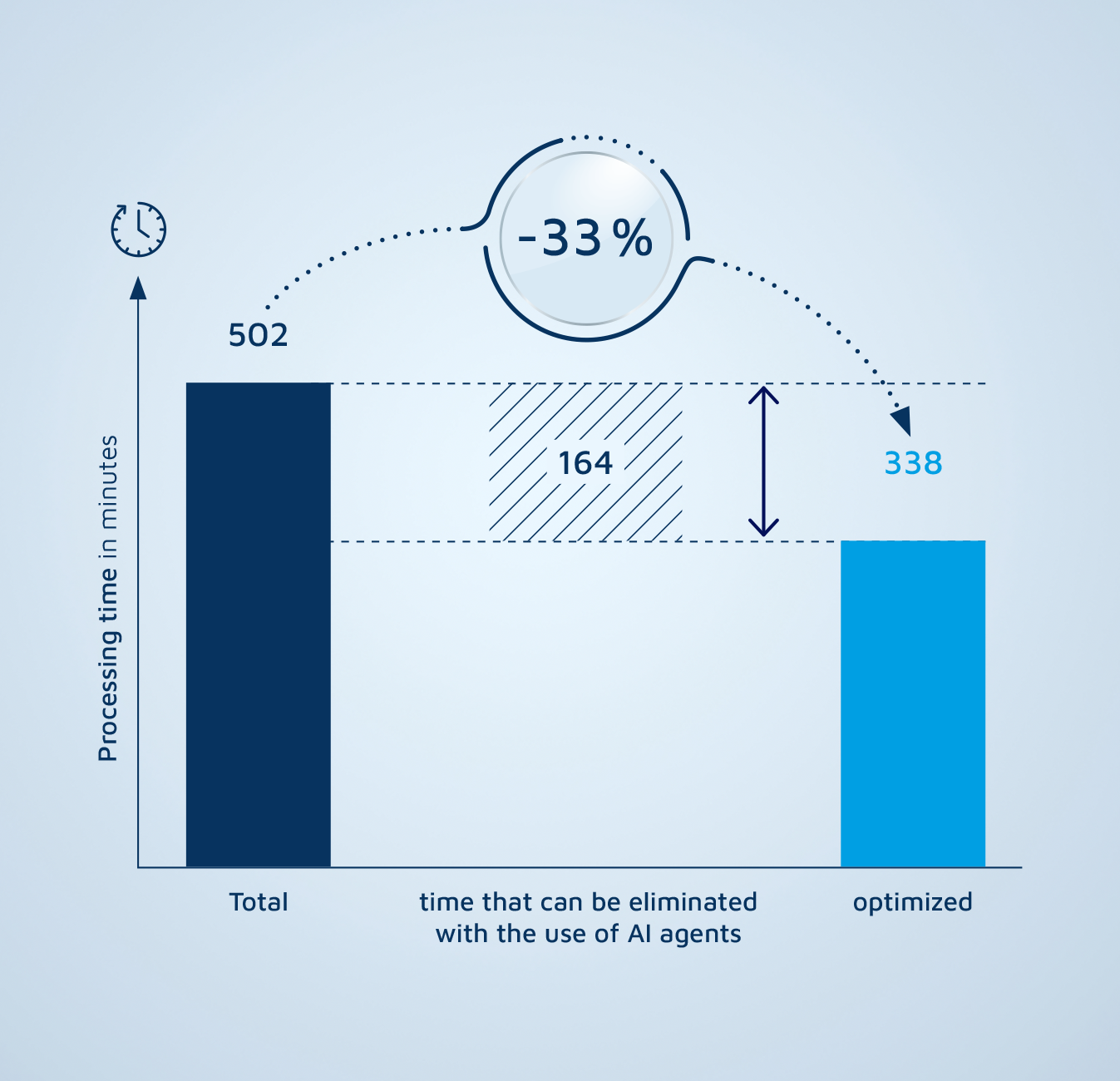
Efficiency Gains

The AI agent system supports the consultant throughout the process. In the first step, the necessary information and documents are identified on a case-by-case basis; in the second step, the quality of the documents is reviewed.

By using an AI agent to assist in verifying the completeness and quality of documents , approximately 16% of processing time can be eliminated in the commercial financing process (risk-relevant).
Why EMPORIAS?

Involving the client organization in a collaborative project culture to ensure sustainable implementation

Consideration of best practices, experience gained from over 20 years and 250 successfully implemented projects

EMPORIAS Glas-Element

Long-term support for clients through to successful implementation for over 70% of existing clients—personal, hands-on, and on an equal footing

Collaboration and exchange of experience with our cooperation partners to implement best-in-class solutions

Chat_Bubble