Union Investment—CO2 Mobility Concept with BI Solution
Increasing regulatory requirements, along with rising expectations from customers, employees, and competitors, present financial institutions with the challenge of making sustainability measurable and manageable.
In collaboration with EMPORIAS, a comprehensive CO₂ mobility concept was therefore developed. At the heart of the solution is a CO₂ mobility calculator built in Power BI, which enables automated data collection and processing while also laying the groundwork for CO₂ budgeting and management at the organizational unit level.
The result: complete transparency regarding CO₂ emissions in corporate mobility, integrated management of CO₂ budgets, and a significant increase in reporting efficiency. Sustainability has thus been successfully embedded in corporate management and made measurable.
Kim Trayser
Head of Business Services, Union Investment Services & IT GmbH
“With EMPORIAS, we have a long-standing partner at our side that implements our sustainability requirements with excellence in both expertise and technology. The CO₂ mobility calculator we developed together in Power BI creates a transparent and robust data foundation and, through professional visualization, enables us for the first time to manage our emissions in a targeted manner. Thanks to increased transparency and visibility, as well as the binding setting of a CO₂ budget as part of our climate strategy, we have been able to strengthen our sense of personal responsibility in sustainability management and significantly reduce our CO₂ emissions in the mobility sector.”
Union Investment—CO₂ Mobility Concept with BI Solution
Why – Background/Challenge
- Increasing regulatory requirements (e.g., CSRD, GHG Protocol, ISO standards) call for robust CO₂ reporting
- Stakeholder expectations are rising: customers, employees, and competitors are demanding credible sustainability strategies
- Sustainability is evolving from a differentiator to a basic requirement
- At the same time, there was a lack of a transparent, consistent database for CO₂ emissions—particularly in the mobility sector
- The key challenge: How can CO₂ emissions be systematically tracked, managed, and actively integrated into corporate management?
How – Project Procedure
1. Standardized carbon footprint assessment:
- Use of established standards (GHG Protocol, ISO 14064-1, VfU emission values)
- Integration of regulatory requirements (CSRD compliance)
- Setting up an automated data collection system
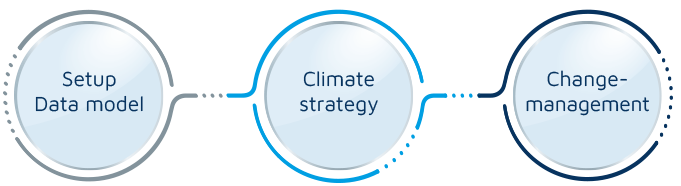
2. CO₂ Climate Strategy:
- Calculation of the carbon footprint
- Establishment of strategic climate goals
- Simulation of control levers and actions
- Inclusion in the Sustainability Report
- Integration into central sustainability management
3. Introduction of a CO₂ mobility calculator:
- Automated calculation of emissions based on defined emission factors
- Ensuring transparency, consistency, and accuracy
- A scalable foundation for reporting and management (based on PowerBI)
4. CO₂ Budgeting & Control Logic
- Calculation of CO₂ budgets by organizational unit
- Monthly Comparison of Budgeted vs. Actual Emissions
- Drill-down features (e.g., by mode of transportation or area)
- IncorporatingCO2 budget compliance into individual performance agreements
What—Results & Added Value
Transparency & Manageability
- Complete transparency regarding CO₂ emissions at both the aggregate and detailed levels
- Implementation of real-time monitoring with drill-down capabilities
Integrated Business Management
- Linking CO₂ data to control processes
- Establishment of a CO₂ budget monitoring system modeled after financial metrics
Efficiency & Automation
- Automated data collection and processing for reporting
- Significant reduction in manual work for the sustainability report
Lasting impact
- Identification of specific measures to reduce emissions
- Promoting personal responsibility within the departments
- Support for the strategic objective: Significant reduction in CO₂ emissions (>40% since 2019)










.svg)


.svg)